This paper is written as a response to that article. I write it in the spirit of
Proverbs 27:17: “As iron sharpens iron, so a man sharpens the countenance of
his friend.” It is also an attempt to provide answers for the basis of my faith.
“Sanctify the Lord God in your hearts and always be ready to give a defense to
everyone who asks you a reason for the hope that is in you, with meekness and
fear” (1 Peter 3:15).
The Greek wording reads “with meekness and fear” (meta prautētos kai
phobou): meekness is gentleness of spirit, while fear is reverence toward God.
In short, the Greek reads, “give an answer for the hope that is within
gentleness toward the person asking, and with reverence toward God — a
defense, never a quarrel.”
Now my formal response:
The author begins her argument with the following statement:
“Recite the Nicene Creed and count how many of Jesus’ teachings you find.
The creed moves from his birth to his crucifixion in a single breath, with no
{mention of} Sermon on the Mount, no command to forgive “up to
seventy‐seven times” (Matthew 18:22, New American Standard Bible, 2020),
nor “I was hungry, and you gave Me something to eat” (Matthew 25:35).
The faith that carries his name was built around who Jesus was said to be; not
what he said to do.
Behind that faith stands a writer who, as far as we know, never met him.”
(The Wayfinder Review, October 22, 2026)
I disagree with the premise of her introduction, which in part questions the
legitimacy of Paul’s witness because, “as far as we know, (Paul) never met him,
and whose interpretation of Jesus shaped the Christology…”
If it is true Paul never met Jesus,(I don’t believe that is true),and his teachings
are therefore suspect, why should the modern reader listen to scholars who
never met Jesus, and who two thousand years after his resurrection, would be
considered knowledgeable on this subject?

I argue that the proposed contradictions between Paul and Jesus are based
upon several misconceptions concerning what these two men taught. As we
will see, such conclusions are in error.
I will not defer to councils, creeds nor scholarly debates. Instead, I will appeal
to the authors of the New Testament to support my assertions.
Context
First, we must consider the context of the events which lead up to Paul’s
ministry. As we will see from the text there is a great deal of evidence that
links Jesus’ teachings with those of Paul’s.
The book of Acts was written by Luke, who was also the author of the gospel
by that name.
“The former account I made, O Theophilus, of all that Jesus began both to do
and teach” (Acts 1:1).
Note, it is Luke who provides the historical backdrop of Paul’s pre-conversion
life and the earliest days of his ministry.
Let’s examine the text. “Then Saul, still breathing threats and murder against
the disciples of the Lord, went to the high priest and asked letters from him to
the synagogues of Damascus, so that if he found any who were of the Way,
whether men or women, he might bring them bound to Jerusalem.”
As he journeyed, he came near Damascus, and suddenly a light shone around
him from heaven. Then he fell to the ground, and heard a voice saying to him,
“Saul, Saul, why are you persecuting Me?”
Saul responded, “Who are You, Lord?”
Then the Lord said, “I am Jesus, whom you are persecuting. It is hard for you
to kick against the goads” (Acts 9:1-5).
A goad was an instrument used to prod an ox to continue moving in the
direction its owner directs. It’s a simple stick with a pointed end used to
motivate the animal through a slight prick to its flesh. While the discomfort is
minimal, it is enough to make the animal change course.
Page 2
An ancient farmer using a goad, behind the ox
Jesus knew Saul was struggling to understand the faith exhibited by those he
was persecuting. His conscience was pulling him to understand the source of
their faith. One could say God was prodding Paul to prepare him to alter his
course. All this was preparatory before his Damascus experience.
After being struck down God began a process of preparing both Paul and the
church to accept each other. It took time for the wounds of mistrust to be
healed.
Difficult Journey
The journey of Paul being accepted within the church was difficult. The church
had suffered greatly at his hand, and they resisted accepting him as a believer.
“Now there was a certain disciple at Damascus named Ananias; and to him the
Lord said in a vision, “Ananias.”
And he said, “Here I am, Lord.”
Page 3
“So the Lord said to him, ‘Arise and go to the street called Straight, andinquire at the house of Judas for one called Saul of Tarsus, for behold, he is
praying. And in a vision he has seen a man named Ananias coming in and
putting his hand on him, so that he might receive his sight.”
Then Ananias answered, “Lord, I have heard from many about this man, how
much harm he has done to Your saints in Jerusalem. And here he has authority
from the chief priests to bind all who call on Your name.”
But the Lord said to him, “Go, for he is a chosen vessel of Mine to bear My
name before Gentiles, kings, and the children of Israel. For I will show him
how many things he must suffer for My name’s sake” (Acts 9:10-16).
What does the text actually say?
Jesus said he had chosen Paul to take the gospel to the world.
If Paul failed in his calling, then God failed to achieve His stated goal. That
goal was nothing less than to send Paul into the world to preach the gospel of
Christ to the nations.
As Saul began to preach boldly that Jesus Christ was the Son of God, and a
small, but growing number of believers began to accept his conversion.
“Then all who heard were amazed, and said, “Is this not he who destroyed
those who called on this name in Jerusalem, and has come here for that
purpose, so that he might bring them bound to the chief priests?”
“But Saul increased all the more in strength, and confounded the Jews who
dwelt in Damascus, proving that this Jesus is the Christ.
Persecution begins outside the church
Now after many days were past, the Jews plotted to kill him. But their plot
became known to Saul. And they watched the gates day and night, to kill him.
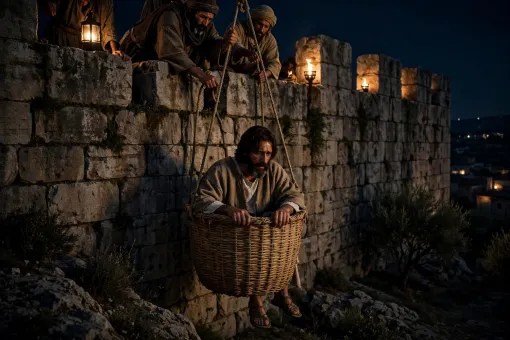
Then the disciples took him by night and let him down through the wall in a
large basket” (Acts 9:21-25). In time this once formidable enemy of Christ
would become his most vocal advocate.
Page 4
Paul’s ministry called into question
Clearly, Paul was preaching “Christ and him crucified” from the earliest days
of his ministry. And as we will see, the leadership of the church supported him
in that effort.
Katheryn Greenleaf claims:
“Paul developed a gospel separate from that of the apostles.” As we will see
such a claim is without merit.
My response
This paper argues that Paul faithfully taught what Jesus taught. A careful
reading of the text demonstrates this fact.
Conflict over circumcision within the church
“Certain men came down from Judea and taught the brethren, “Unless you are
circumcised according to the custom of Moses, you cannot be saved.”
Page 5
Therefore, when Paul and Barnabas had no small dissension and dispute with
them, they determined that Paul and Barnabas and certain others of them
should go up to Jerusalem, to the apostles and elders, about this question”
(Acts 15:1-2).
Clearly, Paul’s ministry was controversial within the newly established church.
The leadership was, at best, confused and at worst contesting the legitimacy of
Paul’s ministry.
How was this perplexing question to be answered?
It took nothing less than to present this matter to the entirety of the church
leadership.
As we will see the matter of circumcision, and therefore, Paul’s ministry, was
in play.
“Now the apostles and elders came together to consider this matter. And when
there had been much dispute, Peter rose up and said to them:
‘Men and brethren, you know that a good while ago God chose among us, that
by my mouth the Gentiles should hear the word of the gospel and believe.
So God, who knows the heart, acknowledged them by giving them the Holy
Spirit, just as He did to us, and made no distinction between us and them,
purifying their hearts by faith.
Now therefore, why do you test God by putting a yoke on the neck of the
disciples which neither our fathers nor we were able to bear?
But we believe that through the grace of the Lord Jesus Christ we shall be
saved in the same manner as they.’” (Acts 15:6-11).
Leadership speaks
“Then all the multitude kept silent and listened to Barnabas and Paul declaring
how many miracles and wonders God had worked through them among the
Gentiles.
And after they had become silent, James answered, saying, “Men and
brethren, listen to me: Simon has declared how God at the first visited the
Gentiles to take out of them a people for His name” (Acts 15:12-15).
Page 6
[Notice,James refers to the writings of Moses to support the conclusions the
apostles were about to announce].
“And with this the words of the prophets agree, just as it is written:
‘“After this I will return
And will rebuild the tabernacle of David, which has fallen down;
I will rebuild its ruins,
And I will set it up;
So that the rest of mankind may seek the Lord,
Even all the Gentiles who are called by My name,
Says the Lord who does all these things.’” (Amos 9:11-12).
James connected the calling of Gentiles to the restoration of the Tabernacle of
David, something already occurring through Christ. Thus, the prophecy’s
fulfillment had begun, though its completion remained future.
Something else the author of “The Jesus of History and Paul’s Christ”
glossed over is found within the text.
The governing apostolic principle is unmistakable: the apostles did not claim
authority to overturn God’s revealed Word.
They established their teaching by demonstrating its agreement with the
Scriptures.
The prophets declared God’s promises, Christ inaugurated their fulfillment,
and the apostles faithfully testified to their meaning and application.
What were the instructions to the Gentiles?
The following verses are often celebrated as the emancipation proclamation to
the gentile from the yoke of Moses (Pentateuch).
Nothing could be further from the truth.
“Known to God from eternity are all His works. Therefore, I judge that we
should not trouble those from among the Gentiles who are turning to God, but
that we write to them to abstain from things polluted by idols, from sexual
immorality, from things strangled, and from blood” (Acts 15:18-20).
Often misunderstood
Page 7
A careful study of the following verses will shine light on this
often-misunderstood section of Scripture.
“Then it pleased the apostles and elders, with the whole church, to send
chosen men of their own company to Antioch with Paul and Barnabas,
namely, Judas who was also named Barsabas, and Silas, leading men among
the brethren.
“They wrote this letter by them:
‘”The apostles, the elders, and the brethren,
To the brethren who are of the Gentiles in Antioch, Syria, and Cilicia:
Greetings.
“Since we have heard that some who went out from us have troubled you with
words, unsettling your souls, saying, “You must be circumcised and keep the
law”—to whom we gave no such commandment it seemed good to us, being
assembled with one accord, to send chosen men to you with our beloved
Barnabas and Paul, men who have risked their lives for the name of our Lord
Jesus Christ.
“We have therefore sent Judas and Silas, who will also report the same things
by word of mouth. For it seemed good to the Holy Spirit, and to us, to lay upon
you no greater burden than these necessary things”‘
What were those necessary things? And how did the leadership conclude what
those things were to be?
The necessary things are:
(a) “that you abstain from things offered to idols (Leviticus 17:7).
(b) from blood (Leviticus 17:10-12)
(c) from things strangled (Leviticus 17:13-14).
(d) and from sexual immorality.” (Leviticus 18:6-26).
A careful look
Take a careful look at what the leadership actually said and did. The change
on circumcision did not negate Moses at all, and the apostles and elders were
united in making sure the Gentile did not come to that conclusion.
Page 8
The injunctions mentioned in their letter to abstain from things polluted by
idols, from sexual immorality, from what is strangled, and from blood — were
not new rules invented by a council.
They were Moses’ own instructions, already given to Israel, directed at
Gentiles turning away from their former pagan ways. These specific
instructions were necessary because the Gentile believer might be tempted to
interpret the decision regarding circumcision as license to adapt Christian
teachings to their previous religion.
Contained within their directive was a direct reference to Moses.
Sadly, that is exactly what happened. When the ‘visible’ church abandoned
apostolic teachings, it replaced it with Greek philosophies. (See
apostolicteaching.org What is Apostolic Teaching and How it Was Preserved?)*
The first century church remained faithful to what Moses and the Prophets
taught. Here are a few examples:
Moses was still being taught, read in the synagogues every Sabbath in every
city (Acts 15:21). Moses himself had instructed Israel to circumcise their
hearts — that is, to repent (Deuteronomy 10:16). Acts 15 is not the Church
setting Moses aside. It is the apostles applying Moses.
What did the apostles actually recognize?
Galatians 2:9 (NKJV) states:
“…James, Cephas, and John, who seemed to be pillars, perceived the grace
that had been given to me, they gave me and Barnabas the right hand of
fellowship, that we should go to the Gentiles and they to the circumcised.”
Notice the sequence:
The apostles recognized the grace God had given Paul.
Page 9
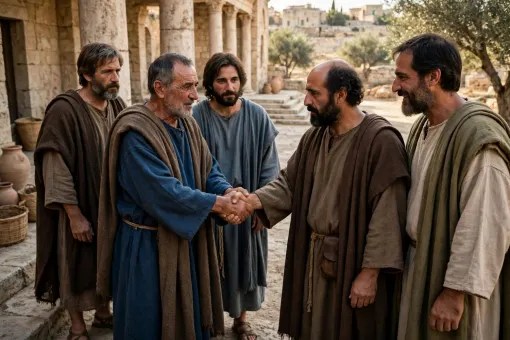
What is the right hand of fellowship? Paul later stated that the apostles
extended the “right hand of fellowship” (Galatians 2:9).
The right hand was associated with agreement, trust, honor, and the
recognition of a relationship or commitment. Giving the right hand could
publicly confirm an agreement.
Koinōnia (fellowship) carries the meanings of:
Partnership
Sharing or participation
Communion or fellowship
Common commitment to a purpose
It means more than simply enjoying someone’s company. In this context, it
communicates a recognized partnership in the work of the gospel.
Paul explains
“But from those who seemed to be something—whatever they were, it makesno difference to me; God shows personal favoritism to no man—for those who
seemed to be something added nothing to me.
“But on the contrary, when they saw that the gospel for the uncircumcised had
been committed to me, as the gospel for the circumcised was to Peter (for He
who worked effectively in Peter for the apostleship to the circumcised also
worked effectively in me toward the Gentiles), and when James, Cephas, and
John, who seemed to be pillars, perceived the grace that had been given to me,
they gave me and Barnabas the right hand of fellowship, that we should go to
the Gentiles and they to the circumcised. They desired only that we should
remember the poor, the very thing which I also was eager to do. (Galatians
2:6-10).
Allow me to quote from the opening comments of Katheryn Greenleaf’s article
“Jesus of History and Paul’s Christ.”
“Jesus preached mercy, justice, and the kingdom, but Paul replaced that
message with a sacrificial Christ he encountered in revelation.
Christianity grew from Paul’s system, not Jesus’ life.” (The Wayfinder Review,
October 22, 2026).
My response
The core of Greek philosophy was rooted in Platonism which supplanted
apostolic teachings of the first century church.
When the visible church abandoned the teachings of the apostles and prophets
it searched for a substitute theological structure. That structure was
formalized through various synods, councils.
“Many Platonic notions were adopted by that church, which understood Plato’s
Forms as God’s thoughts. (Wikipedia)”
The influence and adoption of pagan philosophical reasoning became so deeply
rooted in its body of doctrines that little of the apostles teachings, including
Paul’s, was still in place.
The Church Jesus Christ established was not founded upon the traditions of
men, but upon the teaching of His apostles. The apostles did not regard
themselves as founders of a new religion disconnected from Israel’s
Scriptures. They proclaimed Jesus as the promised Messiah and explained Hislife, death, resurrection, and continuing work through the Law of Moses, the
Prophets, and the Psalms (Luke 24:44–47).
Yet within a relatively short period after the apostles died, Christianity began
to develop practices and forms of government that differed from those
recorded in the New Testament.
The question is not whether Christianity changed. Historical evidence
establishes that it did. The more important question is whether those changes
represented the faithful continuation of apostolic teaching or departures from
it.
In fact, the church of the early second century had changed so much that it is
difficult to recognize it as being associated with the church of the first century.
In his book “The Story of the Christian Church,” Jesse Hurlbut, wrote;
“For fifty years after St. Paul’s life a curtain hangs over the church, through
which we strive vainly to look”
He continued:
“we find a church in many aspects very different from that in the days of St.
Peter and St. Paul.”
It is that church Ms. Greenleaf confuses with that of the apostolic church. As
I have demonstrated throughout this paper it was Paul and the apostles who
strove to maintain sound doctrine within the church.
It’s very shortsighted to blame Paul for the church of the second century.
Page 12
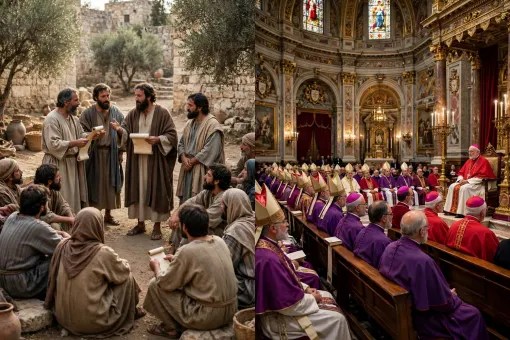
Historian’s observations
Jesse Lyman Hurlbut, The Story of the Christian Church (1918), Chapter V,
“The Age of Shadows” — the quotation used above is verified: “For fifty years
after St. Paul’s life a curtain hangs over the church, through which we strive
vainly to look; and when at last it rises, about 120 A.D. with the writings of the
earliest church-fathers, we find a church in many aspects very different from
that in the days of St. Peter and St. Paul.” (Cite the edition with the page: p. 41
in the 1918-line editions; p. 33 in the 1970 edition.)
Adolf von Harnack, History of Dogma (German 1886–90; English 1894–99) —
his central thesis: “Dogma in its conception and development is a work of the
Greek spirit on the soil of the Gospel.” Harnack argued the early church
restated Jesus’ message in Greek philosophical categories — he called it
“Hellenization” — and saw it as a departure from the original gospel.
Williston Walker, A History of the Christian Church (1918) — AD 70–110 is
one of the most obscure periods in church history; out of the second-centurystruggle with Gnosticism and Montanism came the Catholic Church, with
episcopal organization, a creedal standard, and an authoritative canon, which
“differed much from the Apostolic Church.”
Walter Bauer, Orthodoxy and Heresy in Earliest Christianity (1934) —
argued that in many places (Edessa, Egypt) the earliest detectable Christianity
was of forms later called heresy, and that what became orthodoxy was one
Rome-centered stream that prevailed organizationally and defined its rivals as
deviant.
The changes scholars identify
Separation from Judaism: James D.G. Dunn’s “parting of the ways” model
locates decisive rifts between AD 70 (the Temple destroyed) and 135 (the Bar
Kokhba revolt); by the time of Barnabas and Justin (mid-second century) the
surviving sources are self-consciously non-Jewish.
Revisionist scholars argue the social separation was not complete until the
fourth century. Both models agree: the movement began inside Judaism, and
the church of the second-century record is predominantly Gentile and defines
itself against Judaism.
Practice: Sunday replacing the Sabbath, the rule of faith and the creeds, and
the formation of the canon — see footnotes 1–3.
Recent scholarship (2000–2026) — see footnotes 4–11.
Where they agree, and where they differ
Scholars across the spectrum agree that substantial change occurred — in
government, in Jewish-to-Gentile identity, in Greek philosophical language,
and in creed and canon formation. No mainstream scholar in this research
defends the position that nothing significant changed. They differ on how fast
and how complete the change was, on whether diversity existed from the start,
and on what to call it — corruption (Harnack), legitimate development (Schaff,
Walker), or the winners’ consolidation (Bauer, Ehrman).
Footnotes
- Ignatius, Magnesians 9 — speaks of converts “no longer keeping the
Sabbath.”
- Justin, First Apology 67 (c. 150) — describes the universal Sunday
assembly in his setting. The second century also produced the “rule of faith”
and baptismal confessions (Irenaeus, c. 180) — the precursors of the creeds,
not Nicaea (325). - The core of the New Testament canon (four Gospels, Acts, Paul’s letters)
formed in the second century; the exact 27-book list appears first in
Athanasius (AD 367). - Bart D. Ehrman, Lost Christianity (2003) and The Triumph of
Christianity (2018) — competing Christianity communities (Ebionites,
Marcionites, Gnostics, proto-orthodox), each with its own scriptures; the
proto-orthodox won, canonized, and rewrote the history. Note: his diversity is
present from the first century. - Paula Fredriksen, When Christians Were Jews (Yale, 2018) — the first
generation (30–70) were observant, apocalyptic Jews, Paul included;
“Christian” is an anachronism for them, since it conjures bishops, doctrines,
and creeds. Strong support for how Jewish the first-century movement was —
and therefore how far the later Gentile church travelled. - Daniel Boyarin, Border Lines (2004), and Adam Becker & Annette Yoshiko
Reed (eds.), The Ways That Never Parted (2003) — Judaism and Christianity
were not yet discrete; the border was constructed in the second century by
heresiologists (Justin, Irenaeus) and rabbis together, and was socially
complete only in the fourth century.
7.L. Michael White, From Jesus to Christianity (2004) — four generations:
30–70 (Jewish sect), 70–110, 110–150 (sect to church; separation permanent;
normative self-definition), 150–190 (heresy/orthodoxy delineated, canon
closing ranks). The path, he writes, was “not as straight as we might think.”

Leave a Reply